


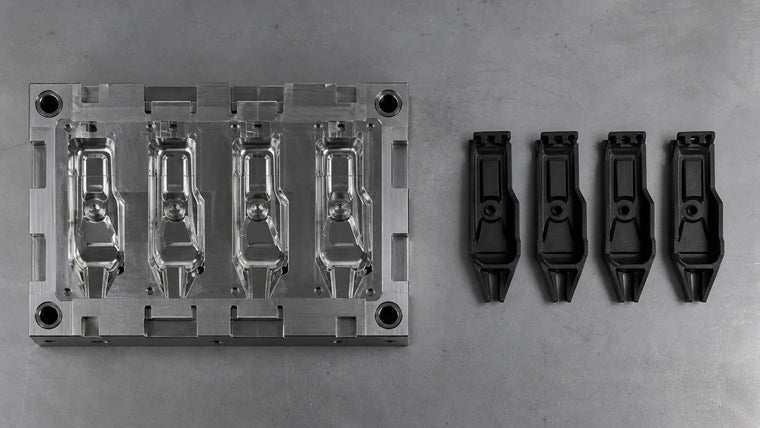
3D Printing as an Injection Moulding Alternative: When It Makes Commercial Sense
When is 3D printing a better alternative to injection moulding? An honest guide to volume, tooling cost, lead times and bridge production from a...
Read the article →SLS, MJF, FDM and SLA under one roof in Warwickshire — 24 production grades, 100+ printers, parts up to 900 mm in one piece. From a single prototype to 100,000 production parts, printed, finished and inspected by the engineers who run the machines.
Most suppliers own one machine and sell you that machine. We run four in-house, so the recommendation follows your part rather than our capacity.

Tough, isotropic nylon with no supports — the widest material range we run, including glass- and carbon-filled grades, and usually the cheapest route at volume.

Repeatable end-use parts with the crispest fine detail and a through-dyed black finish that stays black when it is scratched or machined.

Parts up to 900 mm in a single piece, in carbon- and glass-filled nylons, high-temperature grades and flame-retardant PC — no tooling, no splitting, no redesign.

Where surface finish, fine detail or optical clarity matter more than toughness — including clear, flame-retardant, ESD and ceramic-filled resins.
Upload a STEP or STL and price 1 to 100,000 parts in seconds, in GBP, USD or EUR. No tooling, no minimum order, and a free design-for-additive review on every quote — if a feature won’t hold, we tell you before anything is printed.
Not concept models — components on vehicles, in machines and in the air.
Anyone can buy a printer. What takes years is the process control around it — the inspection, the documentation, and knowing which grade fails in which environment. We print, finish, paint and inspect under one roof, so there is one accountable supplier from quote to delivery.
Every published figure on this site is cited against its ISO test method, and every material page carries an honest limits section telling you where that grade is the wrong call. That is deliberate. You should not find out about moisture absorption after the part is in service.

Automotive OEMs and motorsport, drone and UAV builders, robotics, machine builders and beyond — wherever polymer parts have to perform.
Induction, ducting, brackets and interior parts across 25 vehicle programmes.
Stiff, light airframe components, mounts and sensor housings in carbon fibre nylon.
End-of-arm tooling and grippers — lighter EOAT, faster cycles, same duty rating.
Jigs, fixtures, guards and custom tooling, lighter and cheaper than machined metal.
Corrosion-proof polymer parts for an environment that destroys metal.
Oil & gas, prosthetics, product design, film & TV and more.
Written by the engineers who run the machines — material selection, tolerances, finishing and what parts actually cost.
When is 3D printing a better alternative to injection moulding? An honest guide to volume, tooling cost, lead times and bridge production from a...
Read the article →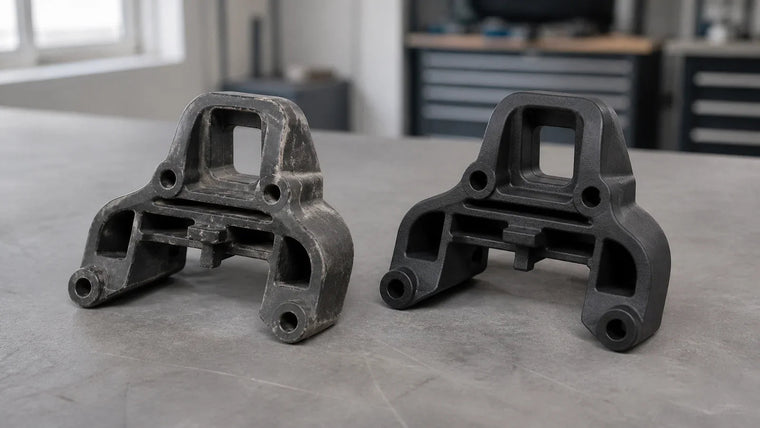
Your supplier just discontinued that part. How UK manufacturers replace obsolete and legacy polymer components with additive manufacturing - scanning, reverse engineering, first article...
Read the article →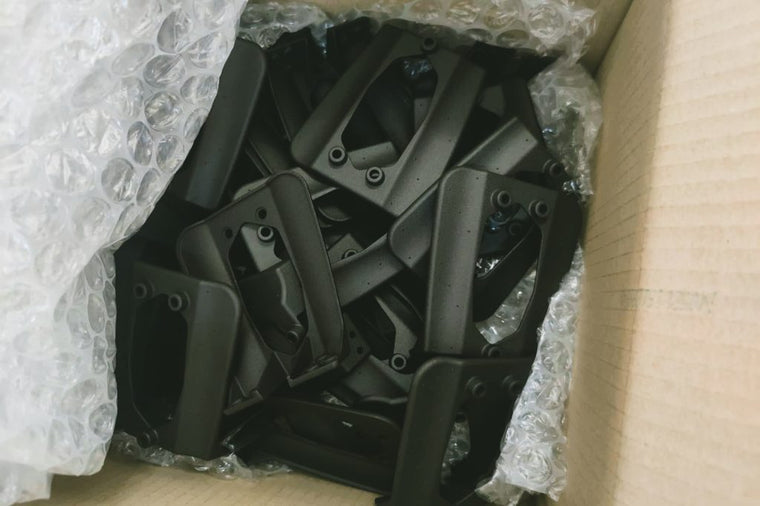
The view that FDM and MJF are prototyping technologies is a decade out of date. What production-grade additive manufacturing actually looks like in the...
Read the article →Instant online pricing on up to 100,000 parts across SLS, MJF, FDM and SLA, with a free design review on every quote.
Printed, finished and inspected at our own ISO 9001 facility in Shipston-on-Stour, Warwickshire. Call 024 7736 0144 · Mon–Thurs 8am–4pm, Fri 8am–2pm.